Price¥16,000Adult (12+) · 2 variants
Valid for3 days¥5,333/day at the lowest price
Who can buyForeign visitors only
TypeUnlimited rides
Checked a while agoWe last checked the official sources for this pass on 2026-10-10. Prices and rules may have changed since: check the official page before you rely on it.
- Validity
- 3 consecutive days from the start date you choose.
- Who can buy
- Holders of a non-Japanese passport only. Original passport needed to buy and collect; carry it while using the pass.
- Format
- Paper pass (works in JR East automatic gates; use staffed gates on other railways).
Prices P
| Adult (12+) | ¥16,000 |
|---|---|
| Child (6–11) | ¥8,000 |
Is it worth it?
Add the normal one-way fares of the rides you plan within 3 days (from the fare charts at stations or a route planner).
Express, seat and Green car charges are usually not included in a pass: leave them out of the fares too unless the pass covers them.
How to use it
- Buy online on JR-EAST Train Reservation or at a JR East Travel Service Center / major station in the area with your passport.
- Use JR East trains in the free area (map on the pass page), including Shinkansen and limited expresses; reserve seats for free before boarding.
- On non-JR lines inside the area, show the pass to staff (Saitama New Urban Transit has no gate support).
- Carry your passport and show it when asked.
Using passes at the gates, passports and seat reservations →
Where to buy
- JR-EAST Train Reservation (online)
- JR East Travel Service Centers and some stations in the pass area
Disruptions in this pass's area
Lines the pass covers where trains do not run now. Ask the operator whether the pass is also valid on its replacement buses or taxis.
Service suspended · 総武線Sobu Main Line: no trains between Yachimata and Naruto after Typhoon No. 25; reopening is expected to take about a month. Replacement buses run on this section. As of 2026-10-10. Source
Service suspended · 内房線Uchibo Line: no trains between Anegasaki and Nagaura after Typhoon No. 25; reopening is expected to take at least three months. Replacement buses carry only 10-20% of a train's load, so expect long waits. As of 2026-10-10. Source
Service suspended · 久留里線Kururi Line: no trains between Kururi and Kazusa-Kameyama after Typhoon No. 25, with no reopening date yet. Replacement buses and taxis run on this section. As of 2026-10-10. Source
What it covers P
Railways
- JR East 東日本旅客鉄道 — 54 sections of lines
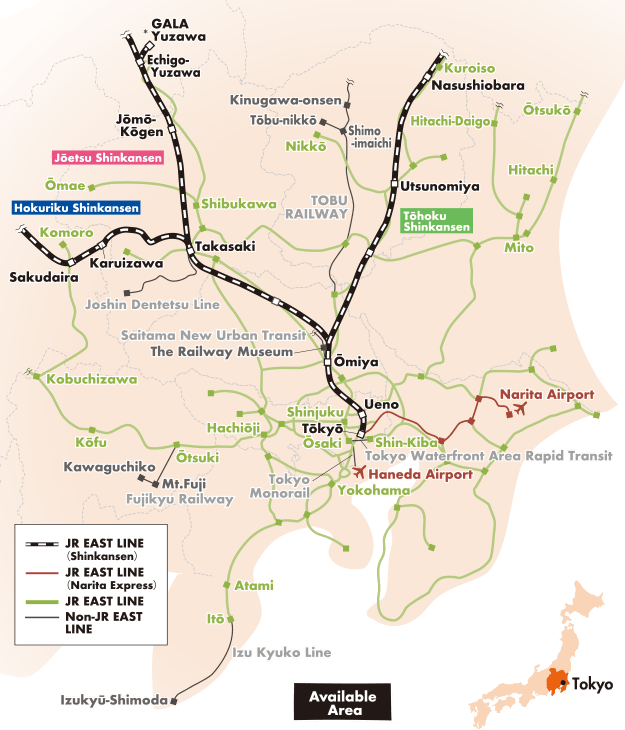
JR East lines inside the free area around Tokyo (e.g. to Nikkō, GALA Yuzawa, Karuizawa, Izu, Fuji, Narita/Boso, Ibaraki); see the map on the pass page (area estimated from the official map).
In Ibaraki, Tochigi, Gunma, Saitama, Chiba, Tokyo, Kanagawa, Niigata, Yamanashi, Nagano, Shizuoka PSections P
- Tohoku Shinkansen Tōkyō – Nasushiobara (estimated from the official map) 東京~那須塩原 · 6 stations
- Joetsu Shinkansen Omiya – Echigo-Yuzawa (estimated from the official map) 大宮~越後湯沢 · 6 stations
- Joetsu Line Echigo-Yuzawa – Gala-Yuzawa (estimated from the official map) 越後湯沢~ガーラ湯沢 · 2 stations
- Hokuriku Shinkansen Takasaki – Sakudaira (estimated from the official map) 高崎~佐久平 · 4 stations
- Tōhoku Main Line Tōkyō – Kuroiso (estimated from the official map) 東京~黒磯 · 49 stations
- JR Nikko Line Utsunomiya – Nikko (estimated from the official map) 宇都宮~日光 · 7 stations
- Joetsu Line Takasaki – Echigo-Yuzawa (estimated from the official map) 高崎~越後湯沢 · 20 stations
- JR Agatsuma Line Shibukawa – Omae (estimated from the official map) 渋川~大前 · 18 stations
- Ryomo Line Shim-Maebashi – Oyama (estimated from the official map) 新前橋~小山 · 19 stations
- Takasaki Line Omiya – Takasaki (estimated from the official map) 大宮~高崎 · 19 stations
- JR Mito Line Oyama – Tomobe (estimated from the official map) 小山~友部 · 16 stations
- Jōban Line Nippori – Otsuko (estimated from the official map) 日暮里~大津港 · 46 stations
- Suigun Line Mito – Hitachi-Daigo (estimated from the official map) 水戸~常陸大子 · 20 stations
- JR Chuo Line Kanda – Kobuchizawa (estimated from the official map) 神田~小淵沢 · 58 stations
- JR Koumi Line Kobuchizawa – Komoro (estimated from the official map) 小淵沢~小諸 · 31 stations
- Tōkaidō Main Line Tōkyō – Atami (estimated from the official map) 東京~熱海 · 33 stations
- Oti Line Atami – Itō (estimated from the official map) 熱海~伊東 · 6 stations
- Sōbu Main Line Tōkyō – Sakura (estimated from the official map) 東京~佐倉 · 27 stations ⚠ disrupted
- JR Narita Line Sakura – Narita Airport Terminal 1 (estimated from the official map) 佐倉~成田空港 · 5 stations
- JR Yokosuka Line Ofuna – Kurihama (estimated from the official map) 大船~久里浜 · 9 stations
- JR Yokohama Line Hachioji – Higashi-Kanagawa (estimated from the official map) 八王子~東神奈川 · 20 stations
- Sagami Line Chigasaki – Hashimoto (estimated from the official map) 茅ヶ崎~橋本 · 18 stations
- Negishi Line Yokohama – Ofuna (estimated from the official map) 横浜~大船 · 12 stations
- Yamanote Line Shinagawa – Tabata (estimated from the official map) 品川~田端 · 17 stations
- JR Akabane Line Ikebukuro – Akabane (estimated from the official map) 池袋~赤羽 · 4 stations
- Tōhoku Main Line Akabane – Omiya (estimated from the official map) 赤羽~大宮 · 12 stations
- Tōhoku Main Line Nippori – Akabane (estimated from the official map) 日暮里~赤羽 · 7 stations
- Tōkaidō Main Line Shinagawa – Tsurumi (estimated from the official map) 品川~鶴見 · 5 stations
- Tōkaidō Main Line Tsurumi – Hazawa yokohama-kokudai (estimated from the official map) 鶴見~羽沢横浜国大 · 2 stations
- JR Nambu Line Tachikawa – Kawasaki (estimated from the official map) 立川~川崎 · 26 stations
- JR Nambu Line Shitte – Hama-Kawasaki (estimated from the official map) 尻手~浜川崎 · 5 stations
- JR Tsurumi Line Tsurumi – Ogimachi (estimated from the official map) 鶴見~扇町 · 10 stations
- JR Tsurumi Line Asano – Umi-Shibaura (estimated from the official map) 浅野~海芝浦 · 3 stations
- JR Tsurumi Line Musashi-Shiraishi – Okawa (estimated from the official map) 武蔵白石~大川 · 2 stations
- JR Musashino Line Fuchu-Hommachi – Nishi-Funabashi (estimated from the official map) 府中本町~西船橋 · 26 stations
- JR Ome Line Tachikawa – Oku-Tama (estimated from the official map) 立川~奥多摩 · 25 stations
- JR Itsukaichi Line Haijima – Musashi-Itsukaichi (estimated from the official map) 拝島~武蔵五日市 · 7 stations
- Hachiko Line Hachioji – Kuragano (estimated from the official map) 八王子~倉賀野 · 23 stations
- Kawagoe Line Omiya – Komagawa (estimated from the official map) 大宮~高麗川 · 11 stations
- Shin'etsu Main Line Takasaki – Yokokawa (estimated from the official map) 高崎~横川 · 8 stations
- JR Karasuyama Line Hoshakuji – Karasuyama (estimated from the official map) 宝積寺~烏山 · 8 stations
- Suigun Line Kami-Sugaya – Hitachi-Ota (estimated from the official map) 上菅谷~常陸太田 · 6 stations
- Sōbu Main Line Ochanomizu – Kinshicho (estimated from the official map) 御茶ノ水~錦糸町 · 5 stations ⚠ disrupted
- Sōbu Main Line Sakura – Chōshi (estimated from the official map) 佐倉~銚子 · 17 stations ⚠ disrupted
- JR Narita Line Abiko – Narita (estimated from the official map) 我孫子~成田 · 10 stations
- JR Narita Line Narita – Matsugishi (estimated from the official map) 成田~松岸 · 14 stations
- Kashima Line Katori – Kashima Soccer Stadium (estimated from the official map) 香取~鹿島サッカースタジアム · 6 stations
- Keiyo Line Tokyo – Soga (estimated from the official map) 東京~蘇我 · 18 stations
- Keiyo Line Nishi-Funabashi – Ichikawa-Shiohama (estimated from the official map) 西船橋~市川塩浜 · 2 stations
- Keiyo Line Nishi-Funabashi – Minami-Funabashi (estimated from the official map) 西船橋~南船橋 · 3 stations
- JR Sotobo Line Chiba – Awa-Kamogawa (estimated from the official map) 千葉~安房鴨川 · 27 stations
- JR Uchibo Line Soga – Awa-Kamogawa (estimated from the official map) 蘇我~安房鴨川 · 30 stations ⚠ disrupted
- Kururi Line Kisarazu – Kazusa-Kameyama (estimated from the official map) 木更津~上総亀山 · 14 stations ⚠ disrupted
- JR Togane Line Oami – Naruto (estimated from the official map) 大網~成東 · 5 stations
Some sections were read off JR East's area map: check the official map before you buy.
- Tokyo Monorail 東京モノレール — all lines
1 whole line
- Tokyo Monorail Haneda Airport Line 東京モノレール羽田線
- Izukyū (Izu Kyūkō) 伊豆急行 — all lines
1 whole line
- Izu Kyūkō Line 伊豆急行線
- Fujikyū Railway (Fuji Kyūkō) 富士山麓電気鉄道 — all lines
Fujisan Express / Fujisan View Express reserved seats and Fuji Tozan Densha cost extra.2 whole lines
- Fujikyuko Line 河口湖線
- Fujikyuko Line 大月線
- Rinkai Line (Tokyo Waterfront Area Rapid Transit) 東京臨海高速鉄道 — all lines
1 whole line
- Rinkai Line 臨海副都心線
- Jōshin Electric Railway 上信電鉄 — all lines
1 whole line
- Joshin Line 上信線
- Saitama New Urban Transit (New Shuttle) 埼玉新都市交通 — 1 section of line
New Shuttle only between Ōmiya and Tetsudō-Hakubutsukan (Railway Museum).Sections P
- Ina Line by New Shuttle Omiya – Tetsudo Hakubutsukan 大宮~鉄道博物館 · 2 stations
- Tobu Railway 東武鉄道 — 3 sections of lines
JR–Tobu through limited expresses Nikko, Kinugawa, SPACIA Kinugawa (reserved ordinary seats; start or end at a JR station; Kurihashi–Shimo-imaichi only on these trains) and Tobu local trains Shimo-imaichi–Tōbu-nikkō / Kinugawa-onsen.Sections P
- Tobu Nikko Line Shimo-Imaichi – Tobu-Nikko 下今市~東武日光 · 3 stations
- Tobu Kinugawa Line Shimo-Imaichi – Kinugawa-onsen 下今市~鬼怒川温泉 · 7 stations
- Tobu Nikko Line Kurihashi – Shimo-Imaichi (riding through only) 栗橋~下今市 · 20 stations
Not includedNot valid on the Tokaido Shinkansen, JR buses, Hayabusa/Komachi trains or GranClass. Green Car needs an extra charge. JR East lines outside the free area need a separate ticket.
Sources and quotes checked 2026-10-10
- prices:
発売価格 16,000 円(こども 8,000 円)
— www.jreast.co.jp/press/2025/20260128_ho03.pdf - validity:
有効期間 利用開始日から連続する 3 日
— www.jreast.co.jp/press/2025/20260128_ho03.pdf - covers:
The pass is valid for reserved and non-reserved seats on ordinary cars of local and express trains, as well as limited express trains of Shinkansen and conventional lines of JR EAST lines, all Fujikyu Railway, Izu Kyuko, Tokyo Waterfront Area Rapid Transit (Rinkai), Tokyo Monorail and Joshin Dentetsu lines, as well as Saitama New Urban Transit lines (New Shuttle) between Ōmiya and the Railway Museum within the area indicated on the map.
— www.jreast.co.jp/en/multi/pass/tokyowidepass_terms.html - covers:
*The pass is not valid for the Tokaido Shinkansen or JR buses.
— www.jreast.co.jp/en/multi/pass/tokyowidepass_terms.html - audience:
The JR TOKYO Wide Pass (hereafter, "the pass") is valid only for visitors holding a non-Japanese passport.
— www.jreast.co.jp/en/multi/pass/tokyowidepass_terms.html - area:
Saitama New Urban Transit (Omiya - the Railway Museum)
— www.jreast.co.jp/en/multi/pass/tokyowidepass.html - area:
You can also use regular trains (including rapid trains) from Shimo-imaichi to Tobu-nikko and Kinugawa-onsen on the Tobu Railway line.
— www.jreast.co.jp/en/multi/pass/tokyowidepass.html - area:
Between Kurihashi and Shimo-imaichi, you can only use limited express trains that run through to Tobu Railway.
— www.jreast.co.jp/en/multi/pass/tokyowidepass.html - prefs:
Unlimited use of local, rapid, express, limited express and shinkansen trains operated by JR East in the Kanto Region as well as parts of Nagano, Niigata, Yamanashi and Shizuoka prefectures.
— www.japan-guide.com/e/e2361_06.html - prefs:
Gala Yuzawa Station only operates during the winter and spring.
— www.jreast.co.jp/en/multi/pass/tokyowidepass.html - area (read off the official map): Tokyo Wide Pass "Available Area" map (JR East lines green, Shinkansen black-white): Tōhoku Shinkansen Tōkyō–Ōmiya–Utsunomiya–Nasushiobara; Jōetsu Shinkansen Ōmiya–Takasaki–Jōmō-Kōgen–Echigo-Yuzawa and GALA Yuzawa; Hokuriku Shinkansen Takasaki–Karuizawa–Sakudaira (cut mark beyond). Green lines ending at labelled stations: Utsunomiya–Kuroiso; Utsunomiya–Nikkō; Takasaki–Shibukawa–Echigo-Yuzawa; Shibukawa–Ōmae; Mito–Hitachi–Ōtsukō; Mito–Hitachi-Daigo; Tōkyō–Hachiōji–Ōtsuki–Kōfu–Kobuchizawa; Kobuchizawa–Komoro; Tōkyō–Yokohama–Atami–Itō; N'EX (red) Tōkyō–Narita Airport. Also green: Oyama–Mito, Shin-Maebashi–Oyama, Ōmiya–Takasaki. The other green lines lie wholly inside the shaded "Available Area" and end at their own termini (unlabelled squares): Takasaki–Yokokawa, Kuragano–Hachiōji (Hachikō), Ōmiya–Komagawa (Kawagoe), Tachikawa–Oku-Tama and Haijima–Musashi-Itsukaichi, Hashimoto–Chigasaki (Sagami), Hachiōji–Higashi-Kanagawa (Yokohama), Ōfuna–Kurihama, the Yokohama–Ōfuna loop (Negishi), Hōshakuji–Karasuyama, Kami-Sugaya–Hitachi-Ōta, Abiko–Narita–Katori–Chōshi, Katori–Kashima (Kashima Line), Chiba–Sakura–Chōshi, Ōami–Narutō (Tōgane), the Bōsō loop Chiba–Ōami–Awa-Kamogawa–Tateyama–Kisarazu–Soga with Kisarazu–Kazusa-Kameyama (Kururi), Tōkyō–Shin-Kiba–Soga (Keiyō); the dense Tokyo-area lines inside the area (Yamanote, Saikyō, Musashino, Nambu, Tsurumi, Sōbu local, Yokosuka-line Shinagawa–Musashi-Kosugi) are taken as whole lines. Lines leaving the area carry cut marks after Kuroiso, Hitachi-Daigo, Ōtsukō, Kobuchizawa and Sakudaira. — map
- www.jreast.co.jp/press/2025/20260128_ho03.pdf · · checked 2026-10-08
- www.jreast.co.jp/en/multi/pass/tokyowidepass.html · · checked 2026-10-08
- www.jreast.co.jp/en/multi/pass/tokyowidepass_terms.html · · checked 2026-10-08
- www.japan-guide.com/e/e2361_06.html · · checked 2026-10-10
- www.jreast.co.jp/multi/pass/img/tokyowidepass/map_available-area_en.png · · checked 2026-10-10
Review status: draft_unreviewed.